Weather appreciation, not a forecast. Not for route, marine, snowpack or avalanche decisions.
Hover or tap any chart to read a bar. Click one to play from there.
The forecast, as the song reads it
Pressure: the low drone, the chords, and the deep drops
Triangles mark the bars where pressure moves 6 hPa or more in six hours. A fall brings a timpani hit, the tuba sinking and the Bear Sax (a baritone sax an octave below the chord root) sliding down with a sub drop under it; a rise brings a timpani roll and rising violins. In a fall of 3 hPa or more the sax holds the root and the drone's third becomes a fourth. The dotted lines at 3 and 6 hPa are compositional thresholds.
Wind: surface and 3 km up
Directions are where the wind comes from, north at the top. The three shaded sectors decide which steps of the bar the congas accent: wind from 45° to 225° (labelled S/E) accents steps 1, 4, 7, 10 and 13; from 225° to 290° (W), steps 1, 5, 8, 11 and 14; from 290° through north to 45° (N), steps 1, 4, 8, 11 and 14. The sector labels only give three different patterns. The angle between the needles is the shear: under 60 degrees the harp counter-line is a third above, 60 to 120 a fifth, over 120 a seventh.
Temperatures near the ground and aloft
The song voices rain and snow from the model's own amounts. This plane shows the temperatures around them (the 850 hPa value is not heard): in the opening storm the ground is near 3 °C while 850 hPa, about 1.5 km up, is far below freezing.
Sun and the day
Each quarter of the ring is the six hours before its time stamp, which is the window the model's radiation and rain are totalled over. The model gives one radiation value per window. The song spreads it along that window's daylight curve (the sine of the sun's height, the same curve the Meridian Chorus uses, rounded at sunrise and sunset), scaled so the window keeps the model's value. The gold shape is that curve, and the best moment of each day sets how loud that day's pulse gets. The hand sweeps the clock time as the bar plays. Noon is at the top and midnight at the bottom, the way the sun climbs and sets.
Chords and mode
Air below 3 °C plays a dark minor loop in D Aeolian (i, VI, iv, VII); air at 3 °C or above plays a brighter D Dorian loop (i, IV, VII, IV). Pressure level drifts the loop up or down the scale. The pitched parts take their notes from the chord (the harp counter-line can add a seventh, and the drone's suspension adds a fourth), so everything stays inside one scale.
What each sound reads
| Sound | Reads | Input |
|---|---|---|
| Hats, shaker, kicks (the pulse) | Sun: the model's downward shortwave radiation (W/m², a mean over the six hours before each time), spread along the day's daylight curve. As the sun climbs: offbeat hats, then backbeat kicks and the shaker, then the snare, then sixteenth hats. Night: two soft kicks, and the night hand drums take over (next row). The best moment of each day, against the strongest in the run, sets how loud the pulse gets | D |
| Drum kit, snare, ghost notes, crash | Rain (mm) plus snow (cm) in the six hours, divided by 4 and capped at 1: the “weight” of the drums. A crash sounds when the weight first passes 0.5, on the first bar of a day with weight above 0.1, and on the first bar of the song | A |
| Log drums and marimba | Rain; more notes the harder it falls | D |
| Glock, triangle, bell tree | Snow; a bell tree when it starts | D |
| Night hand drums | The mirror of the sun pulse: as the sun gate closes at dusk, a loose heartbeat of low conga, log drum and brushed tambourine comes up. Each hit is drawn from a probability for its step (most likely on beat 1, then the “and” of 3) and nudged a few milliseconds off the grid. 10 m wind sets the density (calm: sparser; 40 km/h: nearly twice as busy). Rain brings the kit instead, so they go quiet in a storm | A |
| Congas | 10 m wind speed sets how many hits in the 16 steps (3 to 9); the wind's direction picks which steps are accented (sets above) | R |
| Cello pizzicato | 700 hPa wind speed (about 3 km up) | R |
| Harp counter-line | The angle between the 10 m and 700 hPa wind directions (shear): under 60° a third above the harp line, 60 to 120° a fifth, over 120° a seventh | D |
| Harp line | Notes from the chord; an octave higher when the air is 6 °C or warmer; the gap between temperature and dew point sets how loud (drier air, quieter) | R |
| Chord loop, tuba riff | 2 m temperature picks the mode (3 °C or warmer: Dorian, colder: Aeolian); pressure level drifts the four-chord loop up or down the scale by up to two steps | D |
| Low cello drone | The chord's root, fifth and third. A pressure fall of 3 hPa or more in six hours swaps the third for a fourth (a suspension) for as long as the fall continues | D |
| Bear Sax and sub drop | Pressure. The sax plays an octave under the chord root: held through a fall of 3 hPa or more in six hours, and on a fall of 6 hPa or more it slides down a fifth with a sine sub drop under it | D |
| Timpani, sinking tuba, violin triad | A pressure swing of 6 hPa or more in six hours: a timpani hit and the tuba stepping down on a fall; a timpani roll and a rising violin triad on a rise | D |
| Violin pad | Cloud cover | R |
| Lead-in and wrap-out | Four bars each, on the first and last chords: drone, harp and the deep reed. They frame the run and carry no data | A |
The input column says what the sound reads: R a value taken from the model run as published; D a value worked out from published values (a difference, a ratio, a threshold, a curve); A an assumption, open to change. Every mapping rule is the author's choice. hPa (hectopascals) is the unit of air pressure; 700 hPa is about 3 km up and 850 hPa about 1.5 km. 850 hPa temperature and the freezing level are shown for context and are not heard.
About this edition
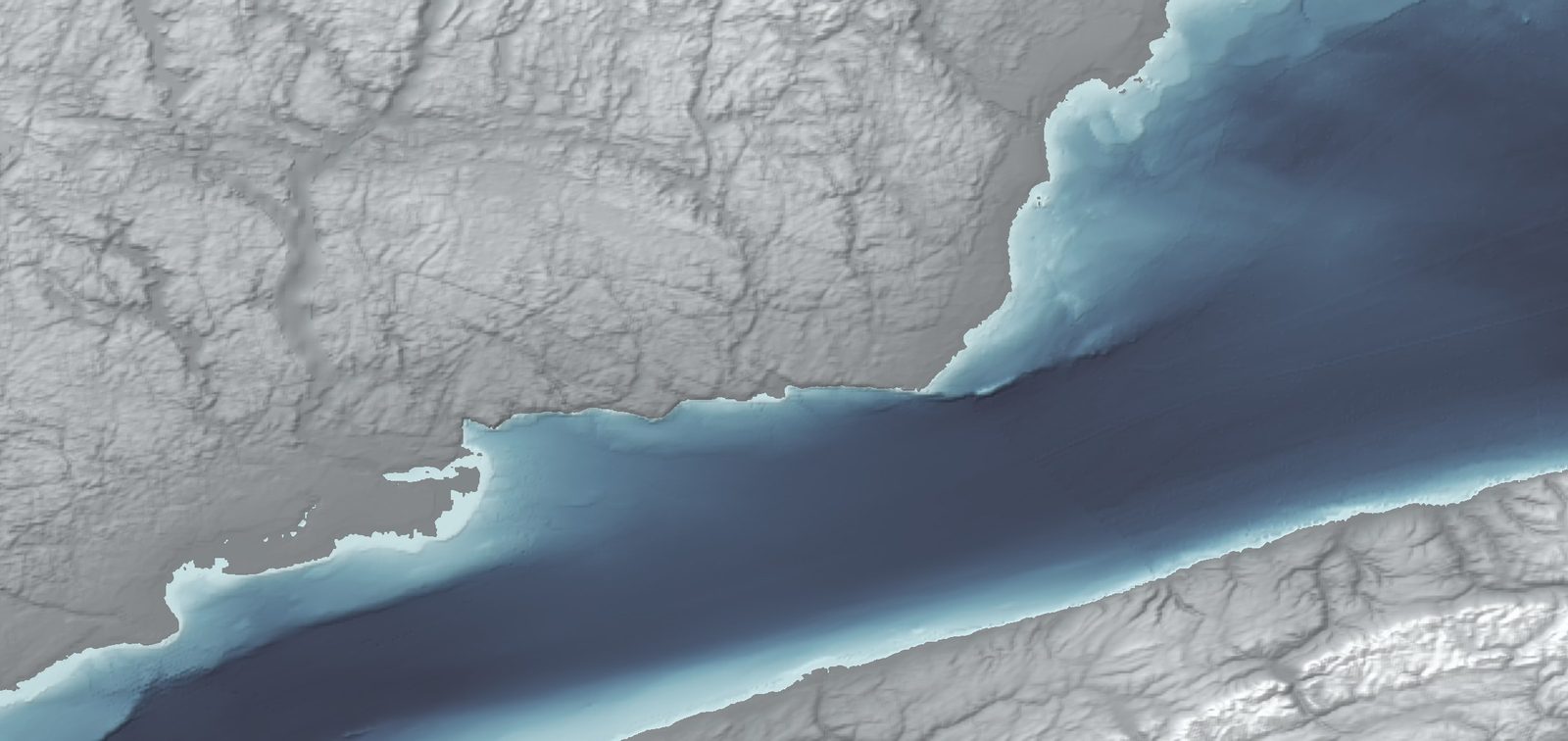
Weather data: ECMWF AIFS Single forecast, run of 16 October 2026 (12 UTC), 6-hourly, taken from ECMWF’s open data and interpolated from the 0.25-degree grid to 49.32 N, 67.62 W, the village of Godbout (marked on the banner; the dashed box is about one 0.25-degree model grid box, so each value covers a stretch of shore and estuary, not a single spot). Times are a fixed UTC-5 (Eastern Standard, with no daylight-saving change), not UTC. The model ends at 15 days, so the last storm is only two bars. It is a model, not an observation, and six-hour steps hide a front’s passage. Snow in cm is the model’s snowfall, counted as one centimetre of snow per millimetre of water.
Forecast data © 2026 European Centre for Medium-Range Weather Forecasts (ECMWF), licensed under CC BY 4.0 (terms). Sea floor and land: GEBCO 2025 Grid (GEBCO Compilation Group, doi 10.5285/37c52e96-24ea-67ce-e063-7086abc05f29), public domain, not for navigation; the banner is a smoothed picture, not a chart.
Instruments: VSCO 2 Community Edition (CC0); Karoryfer Samples Big Rusty Drums, War Tuba and Bear Sax (CC0). Written and built with AI assistance (Claude Code); the groove and its mapping are the author's choices. Godbout lies on the north shore of the St Lawrence, in Nitassinan, the Innu homeland, within the traditional territory of the Innu of Pessamit.
Every bar
Data table (61 bars)
| Bar | Time | T | Cloud | Sun W/m² | Wind 10 m | Wind 700 hPa | hPa | Rain mm | Snow cm | Weight | Mode and chord |
|---|